
Multilayer Facial Rejuvenation
A comprehensive medical approach to facial ageing, combining structural support, collagen stimulation, volume restoration and skin-quality treatments.
Facial ageing affects more than the skin. Changes in facial volume, tissue support, muscle activity, collagen structure and skin quality all contribute to the appearance of ageing. At Aestzenia, we assess these changes individually and develop a personalised treatment strategy designed around your facial anatomy, priorities and expectations.

A structured approach to facial ageing
Each pillar addresses a different dimension of facial ageing. Your assessment determines which may be relevant for you.
Reposition
Improve the appearance of facial support and tissue descent.
With time, the retaining ligaments and fascial supports of the face can lose strength, contributing to a visible descent of facial tissues.
Selected biostimulatory approaches and other appropriate treatments may be considered for patients presenting with loss of tissue firmness and changes in facial contour.
Who may benefit
Patients concerned with loss of facial support, softening of contour or visible tissue descent.
Regenerate
Support collagen remodelling and improve tissue quality.
Collagen structure and dermal quality change with age, affecting firmness, elasticity and the overall quality of the skin.
Calcium hydroxylapatite and poly-L-lactic acid are different technologies with distinct properties and indications, both used as collagen biostimulators.
Who may benefit
Patients concerned with progressive changes in skin quality, firmness and tissue support.
Reconstruct
Restore selected areas of facial volume and proportion.
Fat compartments and bony structures change with age, creating volume deficits and altered facial proportions.
Hyaluronic acid fillers are a versatile option for selected structural and volumetric deficits, with different formulations suited to different purposes.
Who may benefit
Patients with localised volume deficits or changes in facial proportion.
Restore Skin Quality
Improve skin hydration, texture, elasticity and appearance.
Skin quality deteriorates through changes in hydration, texture, tone and barrier function.
Polynucleotides and other appropriate skin-quality treatments may be considered as part of a skin-focused approach.
Who may benefit
Patients concerned with skin texture, hydration, fine lines and overall skin quality.
The five main technologies
Different technologies address different mechanisms of facial ageing. They are not interchangeable, and they are not combined routinely.
Botulinum Toxin
Modulation of selected facial muscle activity.
Potential indications
- Forehead lines
- Glabellar lines
- Crow's feet
- Selected dynamic facial asymmetries
Treatment is individually planned to preserve natural expression. Additional volume is not always the answer to facial laxity or tissue descent.
Explore the dedicated pageHyaluronic Acid
Selective volume restoration, projection and facial proportion.
Potential indications
- Malar volume deficits
- Temporal hollowing
- Chin projection
- Selected jawline irregularities
- Lip enhancement
- Other anatomically appropriate volume deficits
Different formulations have different physical properties and clinical purposes. Additional volume is not always the answer to facial laxity or tissue descent.
Explore the dedicated pageCalcium Hydroxylapatite (CaHA)
Structural support in selected formulations and collagen biostimulation.
Potential indications
- Selected areas of facial support
- Loss of tissue firmness
- Changes in facial contour
- Skin quality and laxity, depending on formulation and indication
There is a difference between structural, diluted and hyperdiluted approaches. Clinical preparation and technique are not published as patient-facing content.
Explore the dedicated pagePoly-L-Lactic Acid (PLLA)
Progressive collagen stimulation and tissue remodelling.
Potential indications
- Selected diffuse volume deficits
- Temporal hollowing
- Progressive changes in facial support
- Selected patients requiring gradual tissue remodelling
Results develop progressively. PLLA is not an immediate filler and is not a substitute for surgical lifting.
Explore the dedicated pagePolynucleotides (PN/PDRN)
Skin quality and tissue repair support.
Potential indications
- Fine lines
- Dehydrated skin
- Poor skin texture
- Selected periorbital and facial skin-quality concerns
Evidence is developing. These products should not be presented as equivalent to structural fillers or powerful lifting treatments.
Explore the dedicated pageUnderstanding your facial ageing pattern
Facial ageing affects several anatomical layers simultaneously, but not equally in every individual.
The main anatomical components
- 1. Skin and epidermis
- 2. Dermis and collagen structure
- 3. Superficial and deep fat compartments
- 4. SMAS and muscular structures
- 5. Retaining ligaments
- 6. Bone and structural support
Ageing affects these layers differently in each individual. Treatment should be based on anatomy and clinical assessment, not age alone.
Six assessment categories
Volume loss
Reduction in selected fat compartments and bony support.
Skin laxity
Loss of tissue firmness and elastic recoil.
Tissue descent
Downward shift of facial tissues and supporting structures.
Loss of facial definition
Reduced clarity of jawline, cheek and contour.
Dynamic wrinkles
Expression-related lines from muscle activity.
Skin-quality deterioration
Changes in texture, hydration, tone and barrier function.
Important: Two people of the same age can have completely different facial ageing patterns. Treatment should be based on anatomy and clinical assessment, not age alone.
Common facial ageing patterns
These are descriptive patterns, not diagnostic categories. They frame the conversation — they do not replace a medical assessment.
A. Young Dynamic Face
A youthful face with good volume, firm skin and minimal ageing signs.
Main concern
Maintenance and prevention.
Objectives
Preserve current appearance; address early dynamic lines; maintain skin quality.
Technologies that may be considered
Botulinum toxin, selected skin-quality treatments, conservative volume correction.
B. Lean Constitutional Face
A naturally lean face with limited subcutaneous volume.
Main concern
Early volume deficit and definition.
Objectives
Restore proportion subtly; avoid over-correction; support skin quality.
Technologies that may be considered
Hyaluronic acid and selected complementary treatments.
C. Volume-Depleted Face
Visible volume loss in cheeks, temples or mid-face.
Main concern
Loss of facial volume and support.
Objectives
Restore volume proportionately; improve contour; respect facial balance.
Technologies that may be considered
Hyaluronic acid, CaHA, PLLA depending on assessment.
D. Lax Face
Reduced tissue firmness with loss of elastic support.
Main concern
Skin laxity and loss of firmness.
Objectives
Improve firmness; support tissue quality; address contour.
Technologies that may be considered
CaHA, PLLA, PN/PDRN and appropriate skin technologies.
E. Descended Face
Visible descent of facial tissues and softening of contour.
Main concern
Tissue descent and support.
Objectives
Improve the appearance of support; address contour; respect anatomy.
Technologies that may be considered
Selected biostimulatory and support-focused approaches.
F. Poor Skin-Quality Face
Dull, dehydrated or textured skin with reduced quality.
Main concern
Skin quality and texture.
Objectives
Improve hydration, texture and tone; support barrier function.
Technologies that may be considered
PN/PDRN, polynucleotides and appropriate skin-quality treatments.
G. Mixed Advanced Ageing
Several ageing components present simultaneously.
Main concern
Multiple components of facial ageing.
Objectives
Plan an individualised, phased combination based on assessment.
Technologies that may be considered
An individually planned combination of the above technologies.
Only a medical assessment can determine the most appropriate treatment. These profiles are not a substitute for consultation.
Your face. Your anatomy. Your treatment plan.
Some patients require only one treatment, while others may benefit from a combination. These are treatment categories, not fixed packages or mandatory combinations.
Facial Prevention
For early signs of facial ageing.
Potential options
Botulinum toxin, selected skin-quality treatments and conservative volume correction.
Facial Harmony
For localised volume deficits and facial asymmetry.
Potential options
Hyaluronic acid and selected complementary treatments.
Facial Regeneration
For patients concerned about firmness, elasticity and skin quality.
Potential options
CaHA, PLLA, PN/PDRN and appropriate skin technologies.
Complete Facial Rejuvenation
For patients presenting with multiple components of facial ageing.
Potential options
An individually planned combination of muscle modulation, structural support, collagen stimulation, volume restoration and skin-quality treatments.
The progressive treatment journey
Treatments may be performed at different appointments, and the sequence is individualised to your clinical priorities.
Assess
Comprehensive medical consultation, facial analysis and photographs.
Plan
Identify the dominant ageing components and prioritise treatment objectives.
Treat
Select the appropriate technologies and organise treatment according to clinical priorities.
Reassess
Evaluate response, healing, skin quality, facial proportions and patient satisfaction.
Maintain
Adapt future treatment according to biological ageing and individual clinical needs.
A science-led approach to facial rejuvenation
Aestzenia's treatment philosophy is informed by published research. These publications are reference material, not treatment protocols.
Facial retaining ligaments: anatomy and clinical applications in facial rejuvenation surgery
Alghoul M, Codner MA
Describes the retaining ligaments of the face and their role in facial ageing, underpinning the structural rationale for multilayer treatment planning.
Facial aging and nasolabial fold: a systematic review and meta-analysis
Gierloff M et al.
Documents the changes in facial fat compartments with age, supporting an anatomy-based rather than age-based approach to treatment.
Calcium hydroxylapatite for facial rejuvenation: an evidence-based review
Marmur ES et al.
Reviews the structural and biostimulatory properties of CaHA, relevant to the Regenerate pillar.
Poly-L-lactic acid for soft tissue augmentation: a literature review
Lowe NJ et al.
Reviews the progressive collagen-stimulating mechanism of PLLA and its role in gradual tissue remodelling.
These references distinguish between anatomical studies, clinical reviews and expert consensus. They are not presented as proof of superiority for any specific combination of treatments.
Start with a medical facial assessment
You do not need to know which product or treatment you need. We begin by understanding your concerns, assessing your facial anatomy and discussing the options that may be appropriate.
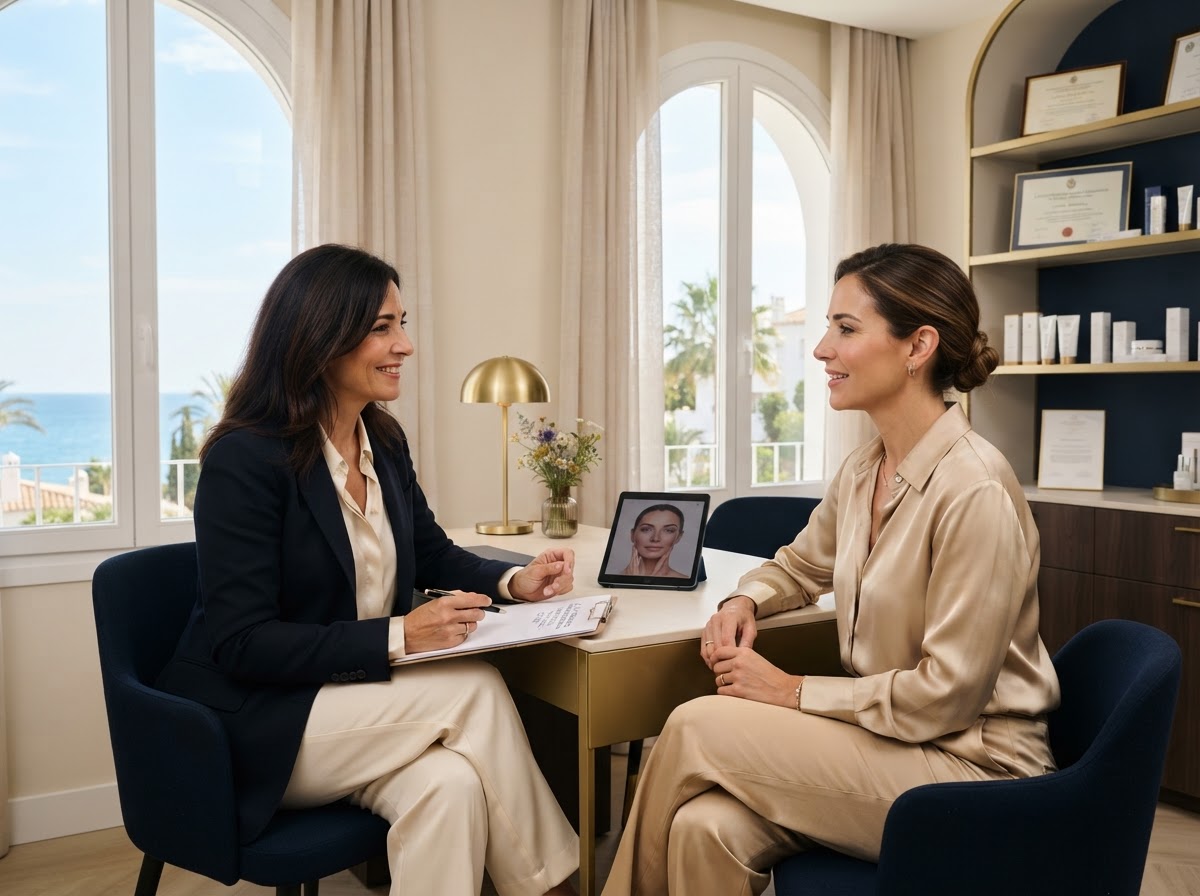
Advanced facial rejuvenation in La Zenia, Costa Blanca
Aestzenia provides advanced, medically-led facial rejuvenation for patients from La Zenia, Orihuela Costa, Torrevieja and across the Costa Blanca. We welcome English-speaking international patients living in or visiting the region.
Frequently asked questions
What is multilayer facial rejuvenation?
A comprehensive approach to facial ageing that addresses several anatomical and biological components — structural support, collagen, volume and skin quality — within a single, personalised treatment strategy. It is not a fixed combination of products; it is a structured, medically-led framework.
How do I know which treatment I need?
You do not need to decide before your consultation. Your needs and goals are assessed individually, and the appropriate options are explained to you. Treatment selection is based on anatomy and clinical assessment, not age alone.
What is the difference between hyaluronic acid and collagen stimulators?
Hyaluronic acid is primarily used for selective volume restoration and proportion. Collagen stimulators, such as CaHA and PLLA, are designed to stimulate a progressive collagen response and improve tissue quality. They address different mechanisms and are not interchangeable.
What is calcium hydroxylapatite?
Calcium hydroxylapatite (CaHA) is a biocompatible material used in aesthetic medicine for selected structural support and collagen biostimulation, depending on formulation and indication.
What is poly-L-lactic acid?
Poly-L-lactic acid (PLLA) is a collagen biostimulator. Results develop progressively over time and it is not an immediate filler or a substitute for surgical lifting.
What are polynucleotides?
Polynucleotides (PN/PDRN) are used to support skin quality, hydration and tissue repair. Evidence for their use is developing, and they are not equivalent to structural fillers or powerful lifting treatments.
Can treatments be combined?
Different technologies address different mechanisms and may be combined when clinically appropriate. However, not every patient requires multiple treatments. Any combination is planned individually following medical assessment.
Will I need several appointments?
Treatments may be performed at different appointments, and the sequence is individualised to your clinical priorities. Some patients require only one treatment, while others benefit from a phased approach.
How long do results last?
Duration varies depending on the technology used, your individual biology, anatomy, lifestyle and other factors. No specific duration is guaranteed.
Can non-surgical treatments replace a facelift?
No. Non-surgical treatments do not replicate surgical results. They are an alternative for patients who are not seeking, or are not suitable for, surgery — not a replacement.
How is my treatment plan determined?
Your treatment plan is determined following a medical consultation and facial assessment. It is based on your anatomy, your priorities and your goals, not on a standard template.
Do you offer consultations in English?
Yes. Consultations can be conducted in English. We welcome international patients living in or visiting the Costa Blanca.
Your face. Your anatomy. Your plan.
Every Aestzenia treatment begins with a personalised medical assessment. Tell us what you would like to improve and we'll help you arrange your consultation.
Areas we serve
La Zenia · Orihuela Costa · Costa Blanca
Available to arrange your consultation
English-speaking service
Consultations can be conducted in English. We welcome international patients across the Costa Blanca.
Medically-led, scientifically informed, individually planned
A consistent, medically-led approach runs through everything we do — from your first facial assessment to any treatment and follow-up. No guaranteed results are offered, and individual outcomes vary.